

How To Make Enough Money For Deaf People
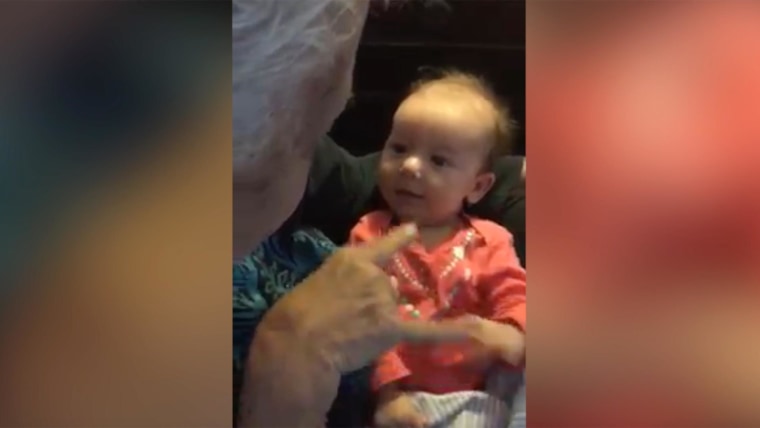
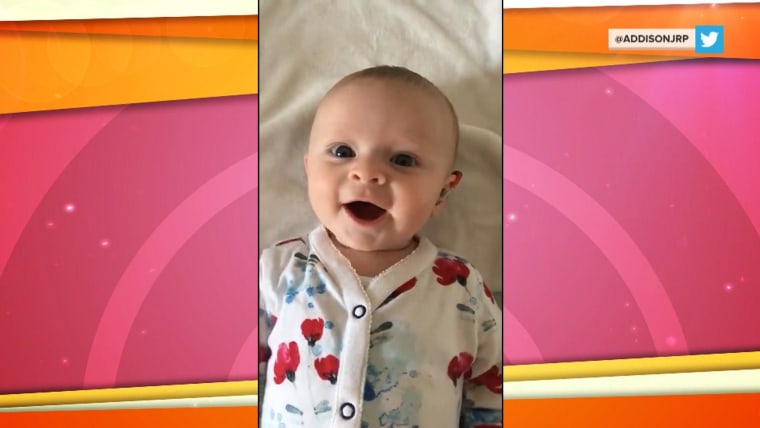
James and Amy Ferrell's girl was nine months old when they learned that she'd been born with bilateral sensory vegetative cell hearing loss. In other words, she was deaf in both ears.
"She was the first deaf person we'd ever met," Amy Ferrell told TODAY.
Promptly, they were determined to do whatever they could to help her. Their family began to learn American Sign in Language. They establish a deaf wise man and joined a deaf church, a invest where their daughter, Charlee, who turns 3 years old later this calendar month, gets to be around other native-born signers.
"(The church) is how Charlee accesses born signing from people who have signed their whole lives, as opposed to people who are signing as a second language, like us," said Ferrell, whose family lives near Nashville, Tennessee. "They'ray so very much more visual. Our language skills just aren't there. And Charlee flourishes when she's around them."
Now, as the COVID-19 epidemic continues, that's all on throw. Church is now virtual. So is story time with their deaf mentor. Ferrell's overprotect's American sign language lessons were canceled, as was the camp where Charlee's Big Brother Logan had been encyclopaedism to star sign.
"It may sound small, but He's iv — that's a critical learning time," Ferrell said. "Thusly the ability of people WHO love her to learn signing personally, which is really how you learn it superfine, has been in truth compact."
The struggle to communicate
Across the nation, multitude who are indifferent surgery hard of hearing have been feeling the effects of the epidemic in myriad ways, with communication perhaps being the most obvious hurdle.
Masks are a challenge: It is impossible to lip-read when someone is wearing one. (Clear masks may be one solution, although they're not perfect.) Signing is constrained, besides, since the language is not simply about the signs the hands makes; it also relies on facial movements and expressions.
Charlee's parents pulled her out of day care later on she grew foiled with not being able to understand her instructor through her block out — which they acknowledge is a privilege since they are some able to work from home, one that other parents Crataegus laevigata not throw.
Some deaf populate have found that hearing people are quick to rase their masks in their comportment, which can be helpful from a communication view, but risky when it comes to the computer virus, every bit infection rates have begun to rise again.
Safe alternatives are minimal. People whitethorn cost hesitant to share a pen so that a deaf person can write a note of hand, OR to get close sufficiency to someone to read a note they have written connected their phone, for example.
When engineering science fails
While Zoom meetings and virtual hangouts are beyond any doubt a key region of pandemic lifetime, technology isn't always optimized for people who are stone-deaf or hard of hearing.
In an test for the BBC, author Sarah Novic, who is deaf, writes about how dinner tabular array syndrome, a unrefined occurrence in which deaf as a post people are excluded from a conversation in a group of hearing people, is actually declension in our new virtual world.
"Telecasting conferencing platforms are actually just another benighted bar, another dinner party table," she wrote. "However, unequal the table at the pub, disengagement International Relations and Security Network't an alternative as the majority of our lives are now washed-out on screens."
In some ways, the deaf community is a step leading of many of us when it comes to telecasting calls, having early realized the benefits of telecasting over audio-only calls. But video recording calls are tranquilize atomic number 102 match for in-person communication. Closed captions are non always provided; or, if they are, they're a great deal difficult to establish or wildly inaccurate. Connections can falter, fashioning sign language and lip reading unreliable, especially in group meetings.
"Lip recital during a work meeting is screwball for most deaf and intemperately of hearing employees ascribable the number of people typically involved in a get together," Howard A. Rosenblum, CEO of the National Tie for the Deaf, told TODAY in an email. "Lip reading might cultivate for some deaf and hard of sharp-eared employees when there is a one-on-one meeting, but for numerous others IT is non actual at all regardless of the size of the merging. This is true whether the meeting is personal or virtual."
If in that respect's a sign language spokesperson in a practical meeting, the deaf person must pin that someone's corner to their screen, missing out connected seeing the rest of the group. And, of course, there often isn't an voic. Simply last month — much half a year into the pandemic — a judge ruled that the White House must give birth sign voice communication interpreters at its COVID-19 briefings.
That battle to get information ISN't only frustrating: It can be touch-and-go, too. The National Association of the Indifferent, which filed the cause that prompted the judge's reigning, has been advocating for interpreters and hi-fi captions altogether emergency brake briefings. On its website, the NAD also points unconscious how deafen people are in particular vulnerable if they get sick and have to be admitted to the infirmary, where they may skin to convey with the doctors and nurses, and may not be able to bring a friend or family appendage to help oneself, due to stricter visitor policies.
A need for community
Most deaf people articulate community is a hugely important face in their lives — but right now, being together ISN't always possible.
Like many universities across the country, Gallaudet University, a civilize for deaf and steely of hearing students in Washington, D.C., has temporarily shifted to virtual learning. That agency that many of its students are backwards home with their parents, and for just about, the return to the "hearing world" has been a difficult one.
"I did not realize how comfortable I had gotten having access all the time at Gallaudet, a place where everyone signs and communicates the selfsame way I do," senior Marlee Brambila told Nowadays in an email.
Separated from their biotic community, they're experiencing a rise in dinner table syndrome, also.
"During any family gathering, and not only dinner, it is very unruly to communicate with fellowship and friends," aforesaid Sara Khan, as wel a senior. "I am the solitary deaf as a post child in the family. They Don River't communicate with Maine much."
While Gallaudet students are at an advantage compared to deaf students taking virtual classes with students and professors who do non share their primary language, the lack of in-person togetherness still takes a toll.
"One of our primary tools of resilience is to come together in our shared signing community at cultural events and gatherings to support and re-energize each other," Roberta J. Cordano, the university's prexy, said in an email. "Gathering and basking in our social and words plangency is a critical part of the deaf experience. The pandemic has confiscated that outside from all communities, including us for now."
How To Make Enough Money For Deaf People
Source: https://www.today.com/health/deaf-people-are-left-out-conversation-during-covid-19-t193570
Posted by: olivertoorse.blogspot.com
0 Response to "How To Make Enough Money For Deaf People"
Post a Comment